

AI is absolutely rewriting how the internet works, but optimizing for LLM visibility misses where the actual ROI exists as the web morphs from a place to find information to the agentic web.
Have you measured how many of your website's visitors come from LLM tools like ChatGPT?
I looked at 12 months of GA4 data across 100 different websites of varying sizes with over 145 million sessions. In this dataset, sessions from ChatGPT amounted to just 0.62% of the volume driven by Google Organic.
That’s not a typo. 0.62%.
When all other LLMs were included in this number, it increased to 0.73%.
I asked Gemini 4 Argon in Antigravity to turn this into a graphic to help me visualize the scale of this:
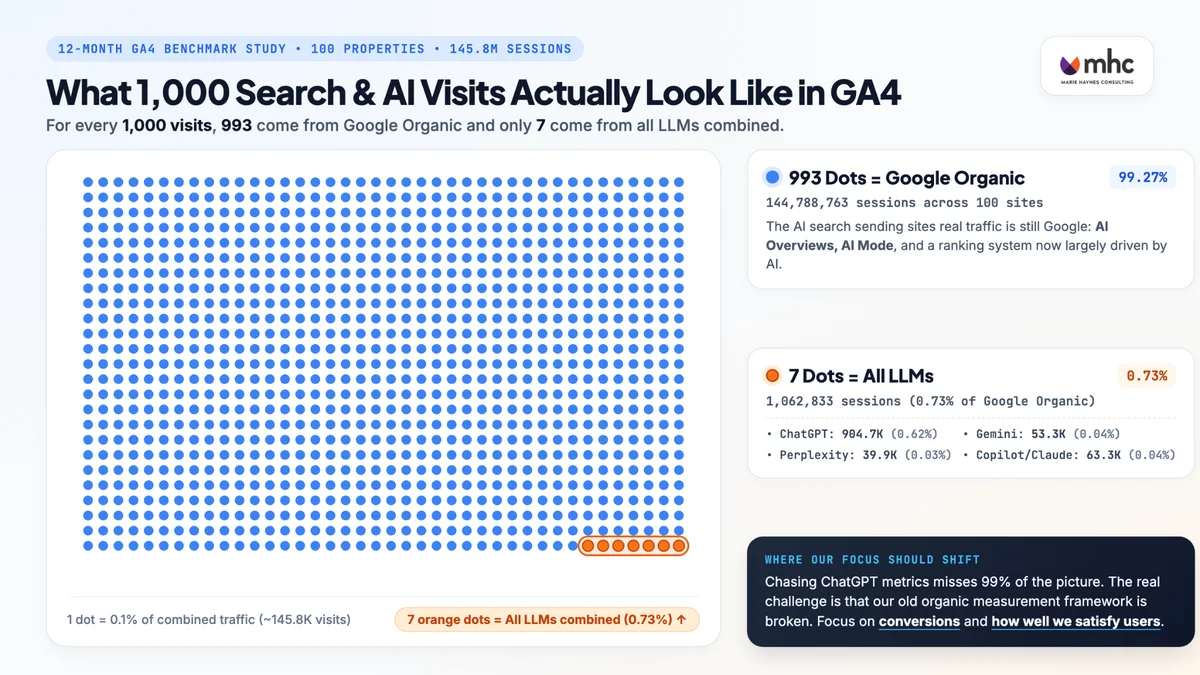
While it’s interesting to measure and try to influence whether your content is being cited by ChatGPT, for the vast majority of sites this traffic is miniscule compared to Google organic visitors!
What about conversions?
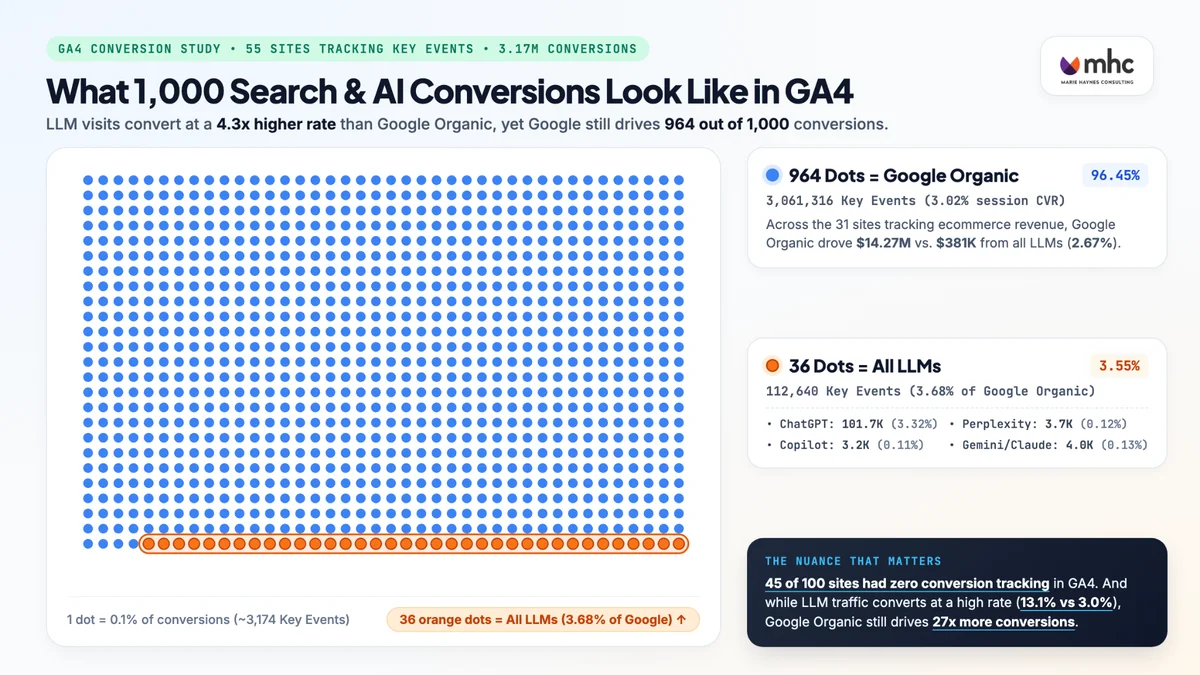
Of the 100 sites in my dataset, 55 were tracking conversions in GA4. I did indeed find that ChatGPT visitors converted at a higher rate.
- Google organic visitors converted at a rate of 3.02%
- ChatGPT visitors converted at a rate of 13.8%
However, even though ChatGPT visitors converted at more than 4.5x the rate of Google organic visitors, Google still drove 96.5% of the total conversions across all channels analyzed.
In my small dataset, Google organic drove 27x more conversions than all LLMs combined.
Will this change as LLM adoption grows?
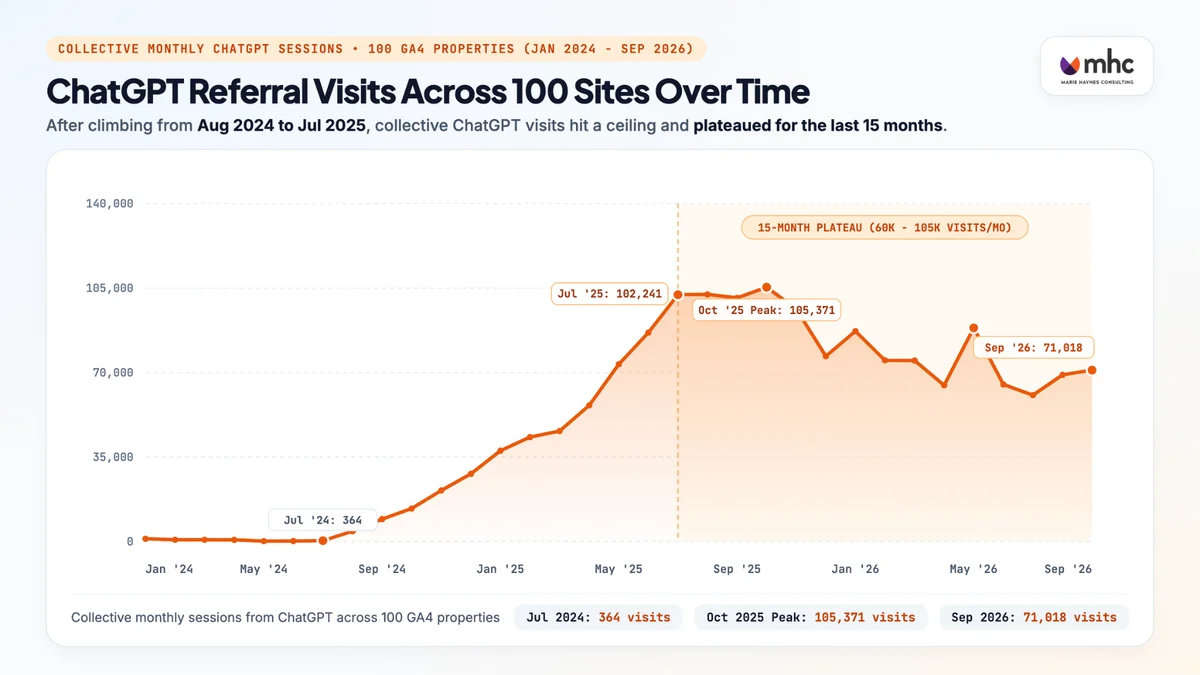
When ChatGPT had been out for a few months, many of us looked at the clicks from ChatGPT, saw they were increasing, and predicted that if the exponential trend continued, LLMs would eventually send far more traffic than Google.
We were wrong.
I tasked Antigravity with looking at those 100 properties and calculating the collective total of visits from ChatGPT. In August of 2025, in conjunction with the release of GPT-5, the exponential growth of ChatGPT sessions ended. In fact, ChatGPT has been sending fewer and fewer visitors to websites since then.
By the way, if you like learning about how AI is changing Search, sign up to get my weekly newsletter. You know you want to be one of the smart SEOs who know what's happening in agentic Search before others are! 😛
Yes, AI is changing Search, but Google is still the most important search engine
There’s so much focus in our industry on “GEO” - optimizing for generative engines. It boggles my mind how much money has been raised and earned by companies that track your mentions in ChatGPT and other LLM tools.
We are chasing the new thing!
We can all see that AI is changing how businesses are found on the internet, but I think we’re missing the point by putting so much emphasis on people finding us via ChatGPT and similar LLMs.
The AI search that is actually sending people to businesses today isn’t ChatGPT. It’s Google.
Between AI overviews, AI Mode and a core ranking system that is now largely driven by AI, millions of people are using AI search every day without ever leaving Google.
We can lament over the fact that our clicks to informational content are drying up, but the reality is that the web is changing. If people are looking to engage with a business like yours, then Google Search is by far the most likely way they will find you.
The problem is, it is difficult for us to measure our progress. Rank tracking means little. Search console gives us some information but little that's immediately actionable. I would encourage you to work on figuring out what a conversion or key event looks like for your business and tracking it. Surprisingly, 45 out of the 100 sites I randomly sampled were not tracking any key events! Then work towards improving those metrics. Focus on improving user satisfaction far more than optimizing for machines. Today’s Google’s ranking systems are heavily influenced by deep learning (AI) algorithms that are continually working to predict what it is a searcher will find the most helpful.
I’d love to see more of my amazing colleagues (aka you perhaps?) publish information to show how you are shifting your efforts in this new and unfamiliar era of Search. Here’s one from Wil Reynolds. If you can figure out how to track and measure your progress as Search changes, you have valuable insights that will help others in our industry!
Start thinking about the opportunities in Agentic Search
Google’s CEO Sundar Pichai recently said that “Search will become an agent manager.”
This means that Search shifts from being a passive way to find links to an active work coordinator. I don’t think anyone, even people from inside Google, can predict how the next era of search will unfold.
At Google I/O last year, I filmed this clip where Sergey Brin was asked what the web will look like in 10 years. He said it was impossible to predict.
“I don’t think we really know what the world looks like in 10 years.”
Then Demis Hassabis said,
"The web is going to change quite a lot if you think about an agent first web, like it doesn’t necessarily need to see renders and things like we do as humans using the web. So I think things will be pretty different in a few years."

I don’t know what the web will look like in 10 years, but we have a good idea of the types of things that are going to change it in the next few years.
Google’s Universal Cart
The Universal Cart aggregates products from multiple retailers into a unified checkout within Google Wallet. It actively monitors price adjustments, promotions, and restocks. Searchers are able to add products from multiple vendors and then check out without ever visiting their sites.
Where the opportunity lies: Get to really know Google’s Merchant Center. There is a new AI assistant in Merchant Center that I find quite helpful. If you can master Merchant Center data, you’ll perhaps be able to see more of your products bundled into Universal Carts.
Universal Commerce Protocol
Governed by Google, Shopify and Stripe, UCP provides the open discovery layer for AI agents to compare inventory and purchase natively, keeping your client as Merchant of record. People will be able to buy your products without ever leaving Google's surfaces.
Where the opportunity lies: We will need to expand technical SEO to include agentic discovery endpoints. There will be need for SEOs who understand /.well-known/ucp and how products and their options are presented from within Merchant Center. I think we’ll find ways to optimize for agentic discovery of products. But much of this will come down to truly having the best products, prices and customer service. Figuring out good ways to do competitor research will be important. And this will be hard because we're entering an era where no two Google searches produce the same results. There will be no easy way to report on this!
WebMCP (Model Context Protocol)
WebMCP enables websites to expose their interactive functions (forms, calculators, booking schedulers) directly to AI agents via declarative markup and imperative APIs.
Where the opportunity lies: There is so much to learn here! I do think it’s a little early for most businesses to be creating WebMCP enabled tools as the technology is still developing. But it’s not too early to start experimenting. I’d recommend brainstorming with AI on what you can offer that agents would want to use via WebMCP. If you missed it, I turned my algo update list into an MCP server.
Intelligent Eyewear
Google doesn't want us to say "AI Glasses" but rather, they are calling it "Intelligent Eyewear." Google says their first intelligent eyewear devices are coming this fall (i.e. any day now). Gemini powered eyewear running Android XR (audio frames with Warby Parker and Gentle Monster, followed by micro-LED display glasses) have the potential to radically change how people search.
Where the opportunity lies: I have heard many say that they won’t take off. I think they will. They may not replace search but expand it, opening up new ways to interact with your customers. Imagine buying a subscription to have your favourite recipe blogger guide you while you’re cooking? Or perhaps you can develop a plumbing assistant that helps for small jobs and makes it easy to call in a professional when needed. It will open up brand new ways to shop - Hey Gemini - look at that shirt she’s wearing, find me one in my size and buy it for me!
Here is Google's Android XR hub with resources to help you develop apps for Intelligent Eyewear.
I am very excited for the opportunities that arise with this technology that will expand Search from something that happens on our screens to something that is around us as we live.
And this is just the start. As we learn how to use AI agentically, I expect all sorts of new opportunities will emerge as well.
A prompt for you to use
Try this:
Read this article I just read by Marie Haynes, https://www.mariehaynes.com/geo-is-a-distraction/ and help me answer these questions: I want to identify practical "Agentic Search and Commerce" opportunities for my business. Search engines like Google are evolving from link indexes into "agent managers" that coordinate tasks and execute transactions (via technologies like Google Universal Cart, the Universal Commerce Protocol / UCP, WebMCP interactive website tools, and multimodal search on smart eyewear). About my business: - Website / Industry: [INSERT URL OR BRIEF DESCRIPTION] - Primary products, services, or offers: [INSERT WHAT YOU SELL OR PROVIDE] - Current primary key event or conversion goal: [E.g., ecommerce purchase, booking a demo, phone call, quote request] Act as an AI Search and Agentic Commerce Strategist. Analyze my business model and give me: 1. Universal Cart & Feed Opportunities: Where could product feed data, stock status, or promotional markup help Google's automated shopping systems bundle or recommend my offers directly at the point of intent? 2. WebMCP Tool Ideas: What interactive function, custom calculator, booking flow, or self-service troubleshooting tool could we build that an autonomous AI agent (like Google-Agent) would love to interact with on a customer's behalf? 3. Ambient & Eyewear Scenarios: How might someone in the real world encounter a problem my business solves (or see a product I sell) while wearing smart glasses? What ambient, "See it, Solve it, or Buy it" use case could we prepare for? 4. Next Steps for My Team: What are 2 realistic, low-lift experiments we can start testing over the next quarter to get ahead of competitors who are only optimizing for standard blue links?
There's no denying that Search as we know it is changing. But chasing ChatGPT citations and LLM mentions is optimizing for the wrong target. I'd encourage you to really study how Google Search and its AI surfaces are representing your brand and working to improve so you are by far the best option for searchers. I think that every business should be investing time in preparing for the agentic web by exploring how UCP, WebMCP, intelligent eyewear and more that has yet to be imagined will provide new challenges and opportunities!
Join Marie's Search Bar Community
Be the first to know what's happening in Search & AI.
Free Member
Get the lastest info as it happens in the SEO & AI News feed.
Search Bar Pro
Tips, Prompts and Strategies for AI & Search from Marie, discussion and Q&A and weekly Search Bar Pro calls.

Comments are closed.