

Google recently made substantial updates to my favorite piece of search documentation: Creating helpful, reliable, people-first content. For years, this has been my favourite Google documentation because it reflects the exact principles Google is training its machine learning ranking systems to replicate.
It amazes me how we don't talk more about this document. As an industry we tend to focus on the ranking algorithms that existed before Google introduced machine learning systems to help predict what is likely to be helpful to a searcher. If you focus on the advice in the helpful content documentation, you are much more likely to align with what Google's ranking systems aim to reward!
Following my own advice about making it easier for searchers to find the thing they are looking for, here is a quick-reference comparison table showing what Google added to the documentation along with some of my thoughts on how to practically apply this.
What Google Added to the Documentation
| Key Area | What Google Added / Changed | My thoughts: Actionable Takeaway |
|---|---|---|
| Main Content (MC) | Explicitly defined as content that directly accomplishes the page purpose (articles, calculators, tools, videos). | Place your primary answer or tool front and center; do not force visitors to scroll past introductory fluff. Oh hey look - this table is doing just that! |
| 1. Effort (Attribute) | Raters evaluate the extent of human work and care involved. Mass generation with little curation is devalued. The systems are designed to reward content that took effort to make. | Prioritize human craftsmanship and original insights over bulk automated production. |
| 2. Originality (Attribute) | Requires unique perspectives, data, or testing not already available across search results. | Avoid commodity content. If an AI summary can rehash your post completely, you are vulnerable. Draw from your real world experience to produce content that no one else can. |
| 3. Skill & Experience (Attribute) | Evaluates whether content shows subject-matter expertise (YMYL) or authentic everyday lived experience. | Align your content with the right type of experience: technical topics need experts; communities value lived experience. |
| 4. Accuracy (Attribute) | Strict factual accuracy requirement; specifically cautions against unreviewed AI hallucinations. | Rigorously fact-check all AI-assisted drafts. Fluent prose is not a substitute for accurate facts. |
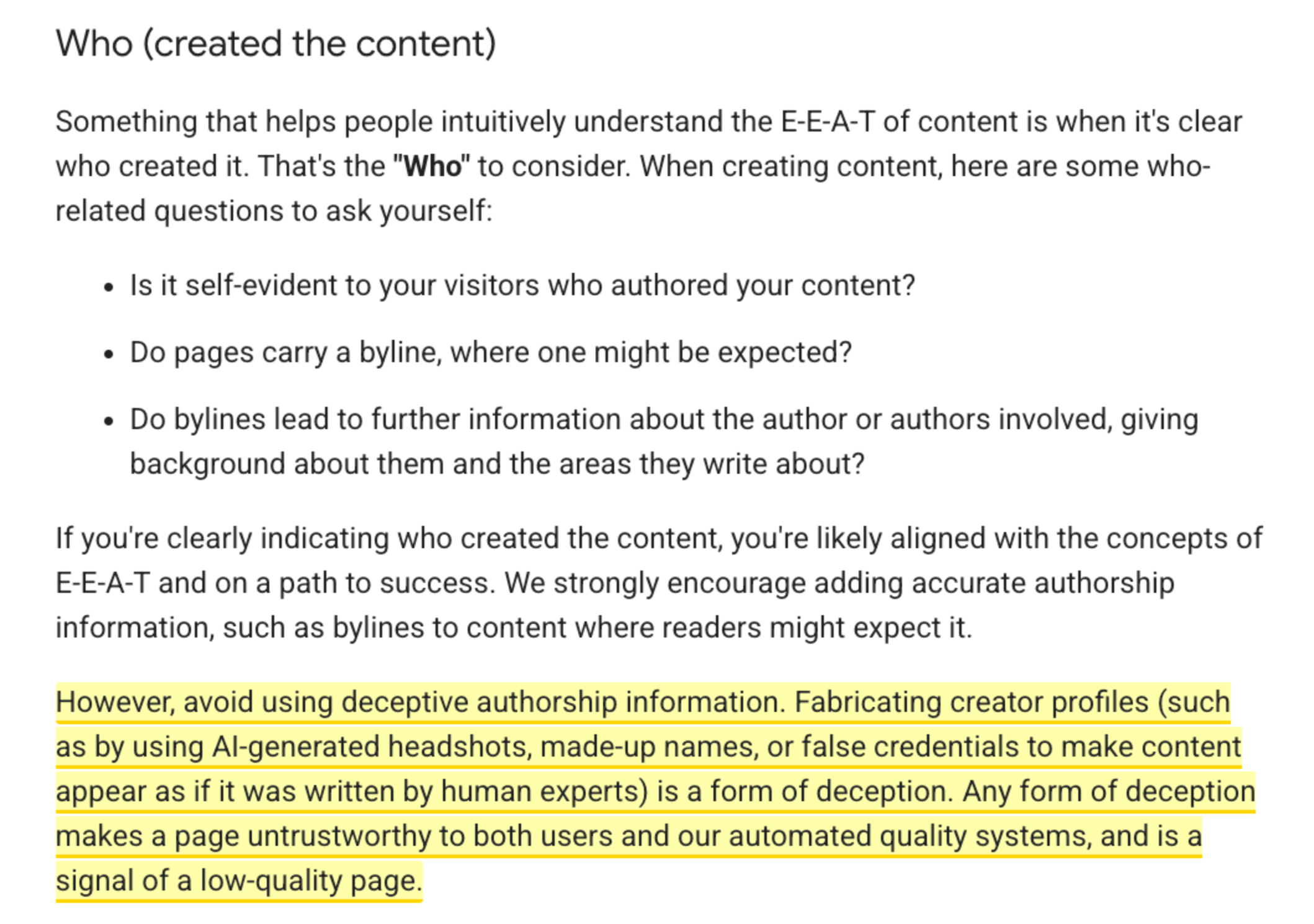
| Deceptive Authorship | Explicitly states that fake personas, fabricated bios, or misleading bylines are signals of low quality. | Always be transparent about real authors and contributors. Never invent fake expert personas. |
| Tabs & Expandable Content | Clarified that tabs and accordions are acceptable for layout cleanliness as long as content is accessible. | Use tabs to reduce clutter, but check user heatmaps to ensure critical answers are actually being seen. |
This whole section is new:
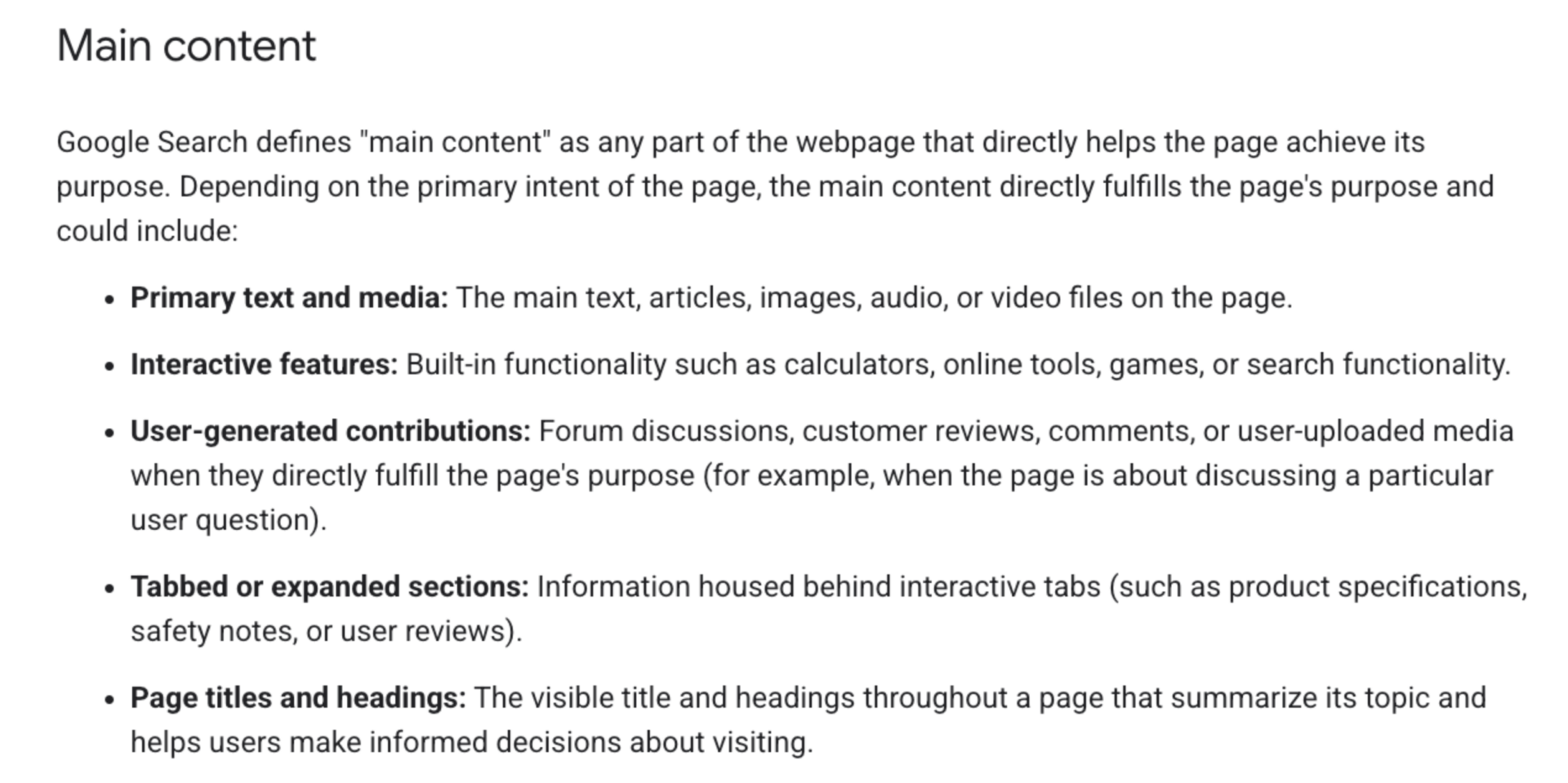
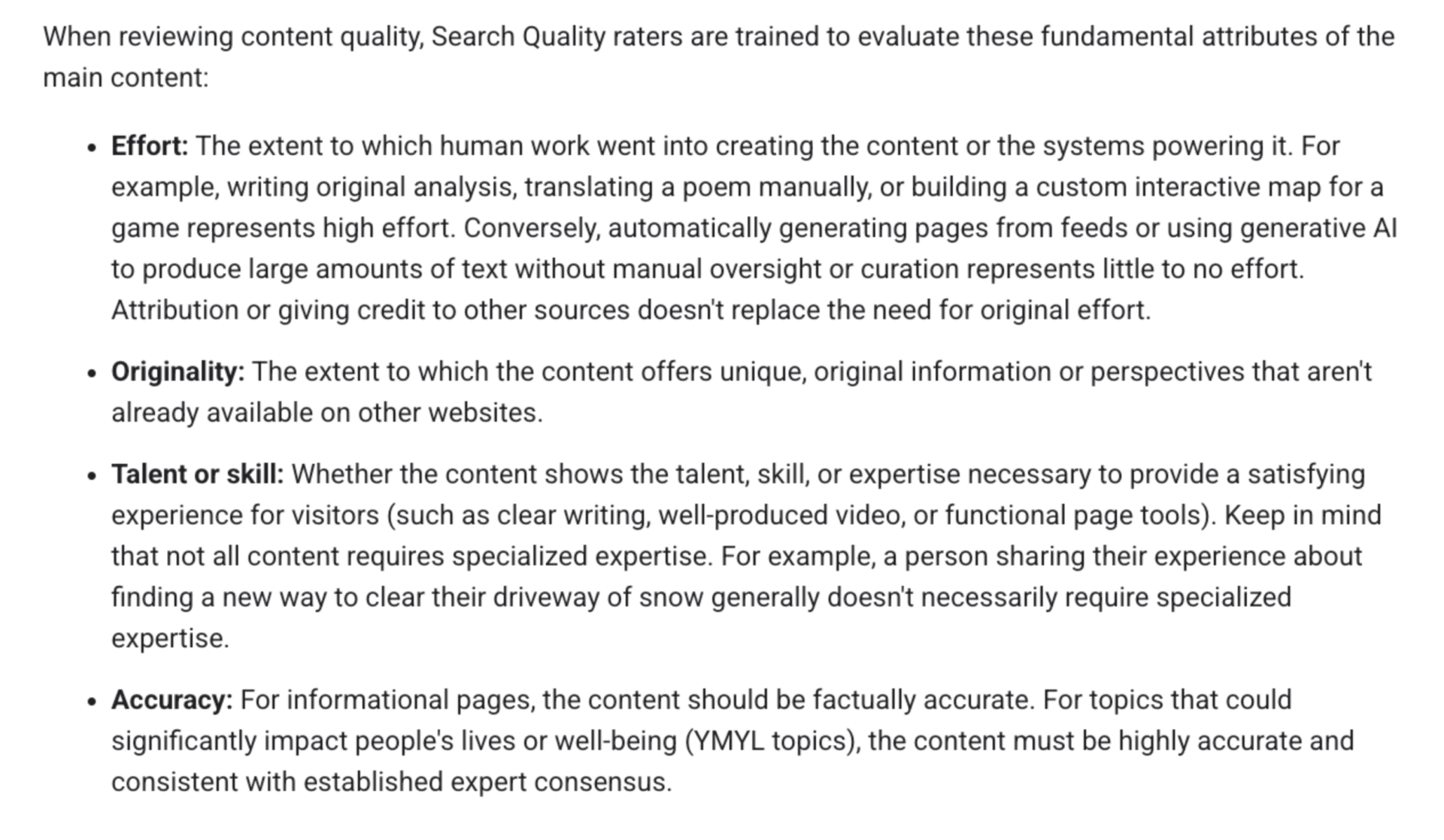
Avoid deceptive authorship
They also added this interesting info. The highlighted part is what's new.
Walk through the new changes with me
In this video I share my thoughts on not just the new changes about main content, but also, why Google's Helpful Content Guidance is so important for ranking.

Why This Documentation Update Matters Now
When the helpful content documentation first appeared in 2022 alongside the initial Helpful Content System, many SEOs struggled to understand how these qualitative concepts could translate into ranking algorithms. We were accustomed to thinking of Google in terms of PageRank, backlink graphs, and matching keywords on a page.
What we now understand is that Google uses these guidelines to train machine learning models. Instead of a hard-coded checklist where an author bio or a specific word count gives you points, Google builds training sets evaluated by human Quality Raters. The machine learning systems then learn to predict what a genuinely helpful, people-first result looks like. The guidelines are a list of the types of things they want the system to reward.
Google recently announced Gemini 4 Argon, their new foundation model. Often when Google has a step up in model capability, we see significant changes to their ranking systems. I suspect that the improvement in AI capabilities across the board also improve the deep learning systems involved in ranking.
I predict we will soon have a significant core update!
If you liked this, you'll love my newsletter:
Or, join us in the Search Bar for up to the minute news on Search and AI.

Comments are closed.